

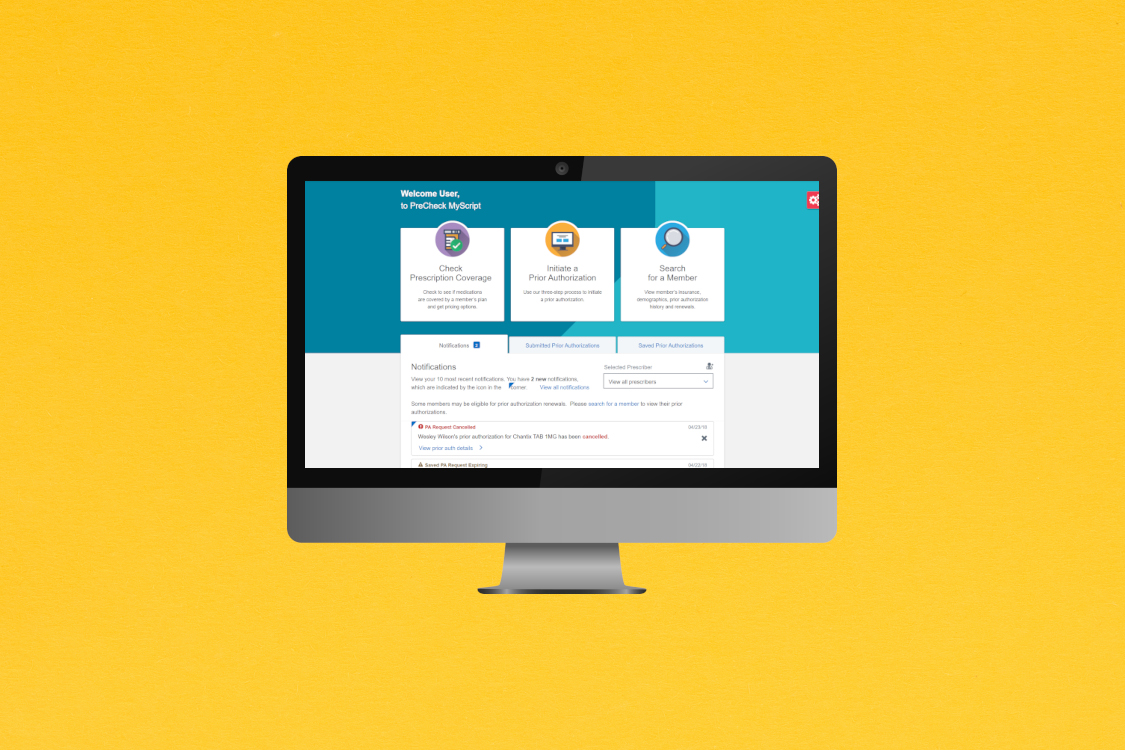
PreCheck MyScript — Case Study Narrative
Overview
PreCheck MyScript is an enterprise application used by healthcare providers to give patients real‑time visibility into the cost of their prescriptions at the moment of prescribing. The tool helps avoid “sticker shock” at the pharmacy counter, reduces abandoned prescriptions, and improves provider satisfaction by surfacing lower‑cost therapeutic alternatives. The initiative originated as an executive design challenge, won internal funding, and quickly became a high‑visibility project with attention from the C‑suite.
I joined the team after the project was already in motion, stepping into a fast‑moving environment with ambitious goals, a tight timeline, and a complex technical landscape.
Context & Problem Space
Healthcare providers often prescribe medications without knowing the patient’s out‑of‑pocket cost. When patients arrive at the pharmacy and discover the price is unexpectedly high, they frequently refuse the prescription. This leads to:
- Lower medication adherence
- Poorer health outcomes
- Increased provider frustration
- Additional call‑backs to find cheaper alternatives
- Lower NPI (Net Promoter) scores for providers
The business goal was clear: reduce cost‑related prescription abandonment and improve provider satisfaction.
But the environment was anything but simple. The organization was a large, siloed enterprise with multiple legacy systems, each holding different pieces of the data needed to calculate real‑time prescription costs. Integrating these sources into a single, coherent experience required careful UX orchestration.
My Role
I was brought in as a senior UX designer with two primary responsibilities:
- Create a fully functional Axure prototype for a large, moderated usability study scheduled roughly one month after my arrival.
- Support research planning and execution, including writing the test script and preparing the interactive flows for the new enterprise usability lab.
Although I joined mid‑stream, my Axure expertise and prior experience moderating enterprise‑level usability tests allowed me to contribute immediately and meaningfully.
Challenges
Several constraints shaped the work:
- High visibility and pressure — the project had executive sponsorship and was closely watched by leadership.
- Complex data dependencies — real‑time cost calculations required pulling from multiple legacy systems.
- A tight timeline — “fast” in this environment meant delivering an MVP in about a year, and the research phase needed to be executed flawlessly.
- A cross‑functional team — three other UX designers, product owners, engineers, and pharmacy domain experts.
- A partially defined product — I joined while the team was still aligning on core workflows and data logic.
These constraints required rapid learning, strong collaboration, and the ability to produce high‑fidelity prototypes that accurately reflected complex system behavior.
Approach
1. Rapid Knowledge Acquisition
To get up to speed quickly, I immersed myself in:
- Existing design artifacts
- Domain documentation
- Team discussions
- Pharmacy workflows
- Provider pain points
Writing the usability test script became a key accelerant. It forced me to deeply understand:
- The intended user journey
- The logic behind cost calculations
- The decision points providers face
- The alternative‑suggestion workflow
This dual role — script writer and prototype builder — gave me a holistic view of the product far faster than traditional onboarding.
2. High‑Fidelity Axure Prototyping
The prototype needed to simulate:
- Real‑time cost calculations
- Alternative medication suggestions
- Insurance coverage variations
- Provider decision flows
- Error states and edge cases
I built a fully interactive Axure prototype that allowed moderators to walk providers through realistic prescribing scenarios.
At the time, our team used Axure for high‑fidelity interaction prototyping, which allowed me to model complex logic for the study. In later projects, I also worked in Figma as our organization transitioned tools; I’m comfortable adapting to whichever platform best supports the fidelity and collaboration needs of the team. I’ve also used Sketch, Evolus Pencil, and pen-and-paper to great effect.
3. Research Planning & Moderation Support
Because I had previously moderated multiple enterprise usability tests, I supported:
- Writing the test script
- Structuring realistic scenarios
- Preparing the lab environment
- Ensuring the prototype behaved consistently
- Coaching colleagues on moderation techniques
This helped the team run a smooth, high‑quality study in the newly established enterprise usability lab.
Outcomes & Impact
Quantitative Impact
The MVP launch produced measurable improvements:
- 22% increase in customer satisfaction, measured through Qualtrics surveys, post‑call feedback, and call‑center anecdotal reports.
- 10% reduction in call‑backs to providers to find lower‑cost alternatives.
These metrics validated the core value proposition: giving providers cost transparency at the moment of prescribing reduces friction for everyone involved.
Qualitative Impact
- Providers expressed relief at having cost information “up front.”
- Call‑center staff reported fewer frustrated patients.
- Internal teams gained a clearer understanding of the prescribing journey.
- The prototype became a reference artifact for engineering and product teams.
Team Impact
My Axure expertise and ability to quickly produce high‑fidelity, test‑ready flows allowed the team to stay on schedule and run a robust research cycle despite the compressed timeline.
Reflection
PreCheck MyScript was a defining project in my enterprise UX career. It reinforced several core strengths:
- Rapid mastery of complex domains
- High‑fidelity prototyping for research and alignment
- Cross‑functional collaboration under pressure
- Ability to step into a moving project and deliver immediate value
- Balancing user needs with technical and organizational constraints
It also demonstrated the power of UX in environments where data, systems, and workflows are deeply intertwined — and where clarity can meaningfully improve both provider and patient experiences.